Revision Lower Eyelid Surgery
Revision Lower Eyelid
Surgery in Korea
Preserving Function.
Prioritizing Long-Term Stability.
Revision lower eyelid surgery requires careful evaluation of previous procedures,
remaining support structures, and realistic treatment planning.
Every revision begins with understanding why the original problem developed.
When Revision Surgery Becomes Necessary
Not every lower eyelid surgery heals exactly as expected.
Some patients continue to experience concerns long after their initial procedure. Others develop new issues that were not present before surgery.
Revision lower eyelid surgery may be considered when previous treatment has resulted in persistent eye bags, hollowing, asymmetry, lower eyelid retraction, contour irregularities, or dissatisfaction with the overall appearance.
Successful revision begins not with correction, but with understanding.
The first step is identifying why the problem occurred.
Common Concerns After Lower Eyelid Surgery
Patients seeking revision surgery often present with concerns such as:
- Hollow appearance beneath the eyes
- Persistent or recurrent eye bags
- Lower eyelid retraction
- Asymmetry
- Irregular contours
- Scar-related changes
- Overcorrection
- Incomplete improvement
Because every revision case is different, treatment planning must be individualized.
The same solution cannot be applied to every patient.
Why Revision Surgery Is Different
Revision surgery is fundamentally different from primary lower eyelid surgery.
Previous procedures may alter anatomy, create scar tissue, reduce available support structures, or limit future surgical options.
As a result, revision surgery often requires more analysis, more planning, and a greater emphasis on preserving remaining tissues.
The objective is not simply to improve appearance.
The objective is to restore balance, support, and long-term stability whenever possible.
Hollowing, Retraction, and Structural Changes
Many revision concerns develop when the relationship between tissue volume and structural support is disrupted.
Excessive fat removal may contribute to hollowing.
Excessive skin removal may increase the risk of lower eyelid retraction.
Scar tissue may alter contour and movement.
Understanding which structures have changed is often more important than focusing solely on visible symptoms.
Successful revision surgery depends on identifying the underlying cause rather than treating appearance alone.
The Importance of Timing
One of the most common mistakes in revision surgery is proceeding too early.
Healing continues long after visible swelling has improved.
In many cases, allowing sufficient time for tissues to stabilize provides a clearer understanding of what correction, if any, may be necessary.
The appropriate timing varies according to the patient’s anatomy, healing process, and surgical history.
Patience is often an important part of revision planning.
Our Revision Philosophy
Not every patient who requests revision surgery should undergo revision surgery.
Some patients benefit from observation.
Others benefit from additional healing time.
When surgery is appropriate, treatment should be based on careful analysis rather than urgency.
Our philosophy emphasizes restraint, preservation, realistic expectations, and long-term stability.
The goal is meaningful improvement rather than aggressive correction.
Before & After
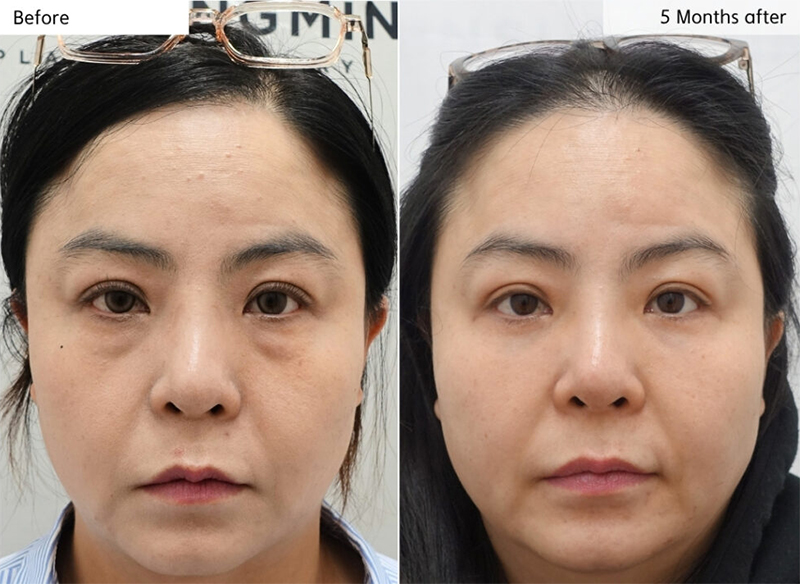
Revision lower eyelid surgery is highly individualized.
Our Before & After gallery includes patients who sought treatment for hollowing, lower eyelid retraction, persistent eye bags, asymmetry, and other concerns following previous surgery.

Why Patients Travel to Korea for Revision Surgery
Many patients seeking revision surgery have already undergone treatment elsewhere.
For this reason, consultation focuses on understanding previous procedures, current concerns, and realistic treatment options.
Our clinic provides physician-directed care from consultation through follow-up, ensuring continuity throughout the treatment process.
For international patients, clear communication and realistic expectations are essential parts of successful revision surgery.
Best Lower Blepharoplasty Surgeon in Korea
Learn how to choose the best lower blepharoplasty surgeon in Korea.
Considering Revision Lower Eyelid Surgery in Korea?
Revision surgery is rarely about making larger changes.
More often, it is about restoring balance, preserving support, and improving long-term stability.
If you are considering revision lower eyelid surgery in Korea, a careful evaluation is the first step.
Looking for a comprehensive guide to revision eyelid surgery?
Explore our complete resource on choosing a revision specialist, understanding surgical judgment, and what to expect before and after surgery.
